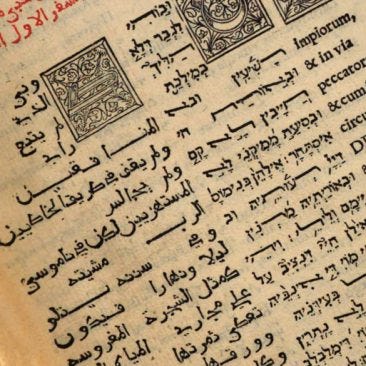
Man of Letters
The adīb is not a literary figure but the disciplined slave who makes the table of the Lord functional through the turn of letters.
Γράμμα (gramma) / א–ד–ב (ʾalef–dalet–bet) / أ–د–ب (ʾalif–dāl–bāʾ)
with ص–ر–ف (ṣād–rāʾ–fāʾ), the turn of letters
In time and out of time, the adīb makes the table of the Lord functional through the turn of letters.
See with what large letters I have written to you with my own hand.
—Galatians 6:11
The Table
The Arabic adīb (أَدِيب) is commonly rendered “man of letters,” and the rendering is correct so long as we refuse to hear it the way English hears it. The adīb is neither a stylist nor an author. He is a man under discipline, adab (أَدَب), from the triliteral أ–د–ب (ʾalif–dāl–bāʾ), whose field in Lane runs from training and correction to the setting of a table. The noun maʾdaba (مَأْدُبَة) is the banquet, the meal prepared and spread for guests. The one formed by the letters is the one who prepares the table. In this function there is no gap between literacy and hospitality, between the scroll and the meal. The man of letters belongs to a table he does not own.
The Hebrew Bible knows this root exactly once, and the one place it appears is the table. In the oracle against the house of Eli, the man of God announces the end of a priesthood that seized the meat before the fat was burned, that fattened itself on the choicest of every offering: “the man whom I do not cut off from my altar will be left to consume your eyes and to grieve your soul,” welaʾadib ʾet-nafšeka (וְלַאֲדִיב אֶת־נַפְשֶׁךָ)—1 Samuel 2:33. The sole biblical occurrence of א–ד–ב (ʾalef–dalet–bet) is a table-word under judgment. Where the servants of the altar treat the table as their possession, the root that trains the man of letters appears as grief, as consumption, as the wasting of the eyes that would not see. Just as God cleaves the seam separating light from dark, or the day of birth from the day of death, the function adīb separates discipline from the priest who eats without discipline.
The scroll signs this judgment in the letters of the priest’s own name. ʿEli (עֵלִי) carries the skeleton of ascent. The third radical of ע–ל–ה (ʿayin–lamed–he), to go up, is a ḥarf ʿilla (حَرْف عِلَّة), a letter of weakness, and under taṣrīf the weak letters turn—he, waw, and yod exchange as a matter of ordinary morphology—which is why the root’s Arabic twin is ع–ل–و (ʿayn–lām–wāw), whose adjective is ʿaliyy (عَلِيّ), the exalted, the high one. In Arabic ears the priest’s name simply is ʿaliyy, the skeleton of height wearing Hebrew vowels. Where radicals shift beyond the weak letters, Ibn Jinnī supplied the license outright: al-ishtiqāq al-kabīr (الاشتقاق الكبير), the greater derivation of al-Khaṣāʾiṣ, by which radicals held in common bind words into a single field without regard for pedigree. The resonance is what the grammar of the third scroll hears. The name says ascent, and the scroll plays against it at every turn. The priest of the ʿolah (עֹלָה), the offering whose very name is the thing that goes up, presides over a house that seizes the flesh before the fat ascends in smoke—1 Samuel 2:15–17—and so the man whose letters say up is given only descent: his eyes grow dim—1 Samuel 3:2—then “his eyes were set, and he could not see,” weʿenaw qama welo yakol lirʾot (וְעֵינָיו קָמָה וְלֹא יָכוֹל לִרְאוֹת)—1 Samuel 4:15—until, at the news that the ark is taken, “he fell from upon the seat backward, and his neck was broken,” wayyippol meʿal-hakkisse ʾaḥorannit…wattiššaber mafrakto (וַיִּפֹּל מֵעַל־הַכִּסֵּא אֲחֹרַנִּית…וַתִּשָּׁבֵר מַפְרַקְתּוֹ)—1 Samuel 4:18. He falls meʿal, from-upon: the preposition of his own name reversed into a height he drops from. And the first letter of his name is ʿayin (עַיִן), which is the eye. The priest whose name opens with the eye-letter is the priest whose eyes fail, whose house is judged with eyes consumed at the table. The colonial etymology of pedigree, which serves sequence and asks only which form begat which, has neither ear nor eye for any of this. The eye that rests on the consonants with ears cannot miss it—and the scroll writes for that eye. This is the discipline Paul hands to the nations in a single word: idete (ἴδετε).
Malachi names the crime without ornament. “The table of the Lord,” šulḥan yahweh (שֻׁלְחַן יְהוָה), “is to be despised”—Malachi 1:7. “The table of the Lord,” šulḥan ʾadonay (שֻׁלְחַן אֲדֹנָי), “is defiled,” mejoʾal (מְגֹאָל)—Malachi 1:12. Paul carries the same table into Corinth in the carrier tongue: “You cannot partake of the table of the Lord,” trapezes kyriou (τραπέζης κυρίου), “and the table of demons”—1 Corinthians 10:21. All three scrolls gather at one table to pose a single question: who will make my meal functional?
The Turn of Letters
The Arab grammarians did not call morphology “morphology.” They called it taṣrīf (تَصْرِيف), from ص–ر–ف (ṣād–rāʾ–fāʾ), the turning. The root turns, it does not change. From three consonants the entire field unfolds, form after form, each one a turning of the same unmoved radicals through time, person, voice, and intensity. The grammar of the third scroll, like the first, names its own operation honestly. There is nothing new under the sun.
The Qurʾan claims this operation for God himself: “thus we turn the signs,” wa-kadhālika nuṣarrifu al-āyāti wa-li-yaqūlū darasta (وَكَذَٰلِكَ نُصَرِّفُ الْآيَاتِ وَلِيَقُولُوا دَرَسْتَ), “and that they may say, ‘you have studied,’ and that we may make it clear for a people who know”—Qurʾan, Sūrat al-Anʿām سورة الأنعام “The Cattle” 6:105. Hear the accusation folded inside the verse. When the signs are turned, the hearers accuse the prophet of scribal study: darasta, you have learned this, you have been to school, you are no oracle but a copyist. The turning of the letters produces the appearance of study, not true meaning. But the turning, in opposition to human meaning, is the discipline of adab, the formation of the adīb. What the scoffers name as disqualification, the scroll names as the pathway of clarity, which comes from him.
This is the function of Galatians 6:11. At the end of the letter Paul takes the pen from the scribe: idete pelikois hymin grammasin egrapsa te eme cheiri (ἴδετε πηλίκοις ὑμῖν γράμμασιν ἔγραψα τῇ ἐμῇ χειρί), “see with what large letters I have written to you with my own hand.” The imperative idete commands Greek eyes to look, not at an argument, but at marks. Look at the grammata. The letters are large, unlovely, the hand of a workman and not a calligrapher, and that is the mark. Paul writes Greek, but the Greek is a veil. Under the carrier alphabet the Semitic hand shows through at the seam, and Paul orders his gentile hearers to fix their eyes on the seam itself. The same gramma that kills when seized as possession—“the letter kills, but the Spirit gives life,” to gramma apoktennei, to de pneuma zoopoiei (τὸ γράμμα ἀποκτέννει, τὸ δὲ πνεῦμα ζῳοποιεῖ), 2 Corinthians 3:6; Romans 2:27–29; Romans 7:6—here stands exposed as the instrument of transmission, held up before the nations: look at the letters. The man of letters writes his study large.
A mark where no eye reaches: “circumcision is of the heart, by the Spirit, not by the letter,” en pneumati ou grammati (ἐν πνεύματι οὐ γράμματι)—Romans 2:29, the command already standing in the first scroll, umaltem ʾet ʿorlat lebabkem (וּמַלְתֶּם אֵת עָרְלַת לְבַבְכֶם), “circumcise the foreskin of your heart”—Deuteronomy 10:16. The large letters are the seen mark; the circumcision of the heart is the unseen, written on Paul’s heart, by a trauma scarred on his body, in travail in his womb—“my children, with whom I am again in labor,” odino (ὠδίνω)—Galatians 4:19—giving birth to a dabar in the earth of the scroll.
And what, precisely, is turned? Not the consonants. In the Semitic scroll the consonants are the skeleton: the rasm (رَسْم), the unpointed trace, three radicals standing in the valley like the bones of Ezekiel’s vision, haʿaṣamot hayebešot (הָעֲצָמוֹת הַיְבֵשׁוֹת), the dry bones commanded to hear—Ezekiel 37:4. What moves around them, the grammarians named with a word that gives the whole game away: the vowels are ḥarakāt (حَرَكَات), movements. The bones remain as the movements turn, and turning itself is life. Hebrew knows the bone as ʿeṣem (עֶצֶם), from ע–צ–ם (ʿayin–ṣade–mem), and the Arabic cognate ع–ظ–م (ʿayn–ẓāʾ–mīm) yields both ʿaẓm, the bone, and ʿaẓīm, the mighty—the skeleton and the majesty are one triliteral. So when the scoffer asks, “Who will give life to the bones when they have decayed?” man yuḥyī al-ʿiẓāma wa-hiya ramīm (مَن يُحْيِي الْعِظَامَ وَهِيَ رَمِيمٌ)—Qurʾan, Sūrat Yā Sīn سورة يس “Yā Sīn” 36:78—he is asking Ezekiel’s question in the third scroll, and receives Ezekiel’s answer: he who produced them the first time will give them life.
The Semitic hand need not write vowels because the consonantal scroll needs nothing from human hands. Its desire is that of a skeleton awaiting breath from its master. By fixing its vowels into letters, Greek embalms the skeleton, sealing the bones in the tomb. The Semitic scribe leaves the breath out, so that every voicing of the scroll is a prophesying to the bones: the one who calls it aloud supplies the ruaḥ (רוּחַ), and the bones hear, “and the breath came into them, and they came to life,” wattabo bahem haruaḥ wayyiḥyu (וַתָּבוֹא בָהֶם הָרוּחַ וַיִּחְיוּ)—Ezekiel 37:10. The scrolls never present themselves to silent eyes: the first calls itself miqraʾ (מִקְרָא), the called-out, and the third calls itself al-qurʾān (الْقُرْآن), the recitation—one triliteral, ק–ר–א (qof–reš–ʾalef) / ق–ر–أ (qāf–rāʾ–ʾalif), to call aloud. In the scrolls there is no reading; there is calling, and there is hearing. Here the polarity of 2 Corinthians 3:6 resolves lexicographically, without recourse to allegory. A bone, a letter, left alone kills; it is dead. Yet the Spirit, the master’s breath, gives life when it enters the bones. But the breath is prophesied to the bones, not to the empty air of the Greeks; pneuma without grammata has nothing to raise. Paul names that emptiness with his own fists: “I box in such a way, as not beating the air,” houtos pykteuo hos ouk aera deron (οὕτως πυκτεύω ὡς οὐκ ἀέρα δέρων)—1 Corinthians 9:26, and he says it in a passage about enkrateia (ἐγκράτεια), the self-discipline of the trained man, which is adab in Greek dress. Breath spent on air is hebel (הֶבֶל), the vapor of Ecclesiastes that the carrier tongue receives as mataiotes (ματαιότης)—vapor mistaken for substance.
Before al-Andalus
To call Paul the adīb of al-Andalus is to invite the historian’s objection: al-Andalus lies seven centuries downstream. The objection is an offering laid on an altar, and the altar belongs to chronos (χρόνος), whom the Greeks had already learned to hear as Kronos the devourer of his own children—the conflation is theirs, not etymology’s, and they made it because they knew what their god did. The historian is a servant of that altar. He attends it faithfully, he keeps its sequence, and the god he serves eats everything set before him, including Abraham. Paul had already refused this altar in the letter under discussion: “you observe days and months and seasons and years,” hemeras paratereisthe kai menas kai kairous kai eniautous (ἡμέρας παρατηρεῖσθε καὶ μῆνας καὶ καιροὺς καὶ ἐνιαυτούς)—Galatians 4:10. To observe the calendar is to serve the elemental powers.
The objection assumes that the scroll develops. The Qurʾan itself dismantles the assumption at its root: mā kāna Ibrāhīmu yahūdiyyan wa-lā naṣrāniyyan wa-lākin kāna ḥanīfan musliman (مَا كَانَ إِبْرَاهِيمُ يَهُودِيًّا وَلَا نَصْرَانِيًّا وَلَٰكِن كَانَ حَنِيفًا مُّسْلِمًا), “Abraham was neither a Jew nor a Christian, but he was a ḥanīf, a submitter”—Qurʾan, Sūrat Āl ʿImrān سورة آل عمران “The Family of ʿImrān” 3:67. Abraham is a submitter before Islam has an era, because submission is a function, not a tribe, let alone a sect or an identity. The scroll assigns its terms without regard for sequence, for the scroll’s original sits outside sequence: “it is in the mother of the scroll with us, exalted, wise,” fī ummi al-kitābi (فِي أُمِّ الْكِتَابِ)—Qurʾan, Sūrat al-Zukhruf سورة الزخرف “The Ornaments of Gold” 43:4. And the scroll’s word for “exalted” there is la-ʿaliyyun (لَعَلِيٌّ)—ع–ل–و again, the skeleton of Eli’s name: the umm al-kitāb bears the very height the priest’s house dropped from the seat. The umm al-kitāb rests with God out of time while its signs are turned, nuṣarrifu, into time.
The first scroll says the same of the prophet himself: beṭerem ʾeṣṣorka babbeṭen yedaʿtika (בְּטֶרֶם אֶצָּרְךָ בַבֶּטֶן יְדַעְתִּיךָ), “before I formed you in the womb I knew you, and before you were born I consecrated you; I have appointed you as a prophet to the nations”—Jeremiah 1:5. The prophetic office precedes the prophet’s body. And the Johannine word performs the grammar outright: prin Abraam genesthai ego eimi (πρὶν Ἀβραὰμ γενέσθαι ἐγώ εἰμι), “before Abraham was born, I am”—John 8:58. For the prophet there is no such thing as time.
Foxes have holes and birds have nests, but the Son of Man has nowhere to lay his head—Matthew 8:20. Abraham, Moses, Paul, Muhammad—none of these men belong to anyone. The prophet is sent for the human race, and the third scroll says so without qualification: wa-mā arsalnāka illā raḥmatan lil-ʿālamīn (وَمَا أَرْسَلْنَاكَ إِلَّا رَحْمَةً لِّلْعَالَمِينَ), “we did not send you except as a mercy for the worlds”—Qurʾan, Sūrat al-Anbiyāʾ سورة الأنبياء “The Prophets” 21:107. Not for a lineage or tribe, not for a caliphate, not for a church—for the ʿālamīn.
In these last days he spoke to us in a Son, whom he appointed heir of all things, through whom he also made the worlds.
By trust we understand that the worlds were fitted together by the word of God, so that what is seen came about from what does not appear [me ek phainomenon (μὴ ἐκ φαινομένων)].
—Hebrews 1:2; 11:3
“What does not appear” refers to the unseen doer in Paul’s grammar. The negation me (μὴ) sits inside the prepositional phrase, not on the verb: eis to me ek phainomenon to blepomenon gegonenai (εἰς τὸ μὴ ἐκ φαινομένων τὸ βλεπόμενον γεγονέναι). The Greek doesn’t deny that the seen has a source; it denies that the source appears. The ek (ἐκ) is asserted—there is a “from,” a doer, an origin—and only its visibility is negated.
The unseen doer stands in the sentence precisely by not appearing in it, the way he stands in the ʿālamīn. And phainomenon is a present participle: not “things that never appeared,” but “things not now appearing”—the doer at work, unseen, ongoing, who posits a dabar (דָּבָר) in the prophetic womb of mercy.
Paul says the same thing at the summit of his longest argument, where the whole question of who belongs collapses into a single sentence: “God has shut up all in disobedience, so that he may show mercy to all,” synekleisen gar ho theos tous pantas eis apeitheian hina tous pantas eleese (συνέκλεισεν γὰρ ὁ θεὸς τοὺς πάντας εἰς ἀπείθειαν ἵνα τοὺς πάντας ἐλεήσῃ)—Romans 11:32. Tous pantas, the all, twice, with no tribal remainder; and eleos (ἔλεος) is the carrier’s rendering of the raḥma field, ر–ح–م (rāʾ–ḥāʾ–mīm), whose Hebrew twin ר–ח–ם (reš–ḥet–mem) names the womb itself, reḥem (רֶחֶם), raḥim (رَحِم). Mercy in the Semitic scrolls is womb-feeling, and Paul’s own sending is stated through that organ: “he who set me apart from my mother’s womb,” ek koilias metros mou (ἐκ κοιλίας μητρός μου), “was pleased to reveal his Son in me so that I might preach him among the nations”—Galatians 1:15–16, in the same letter as the large letters, quoting Jeremiah’s call onto himself. Separated from the womb, sent to the ethne (ἔθνη): the mercy-for-the-worlds of the third scroll, conjugated in the first person. And the sending has one purpose: that, unlike Eli, someone would hear. In Eli’s own house the word bypasses the priest and comes to the boy, and the boy answers with the sentence that joins hearing to slavery in four words: dabber ki šomeaʿ ʿabdeka (דַּבֵּר כִּי שֹׁמֵעַ עַבְדֶּךָ), “speak, for your slave hears”—1 Samuel 3:10. The signs of mercy are not hidden; they are turned before us on every side, “we will show them our signs on the horizons and in themselves,” sa-nurīhim āyātinā fī al-āfāqi wa-fī anfusihim (سَنُرِيهِمْ آيَاتِنَا فِي الْآفَاقِ وَفِي أَنفُسِهِمْ)—Qurʾan, Sūrat Fuṣṣilat سورة فصلت “Made Distinct” 41:53. Hos echei ota akouein akoueto (ὃς ἔχει ὦτα ἀκούειν ἀκουέτω): he who has ears to hear, let him hear—Mark 4:9.
So al-Andalus, in this essay, is not a caliphate. It is a station in the morphology of the scroll: wherever the letters are turned so that the nations may eat at the Semitic table, there al-Andalus is. Córdoba, Galatia, and earlier, and now, if now can be held in anyone’s hand but his. Paul does not stand before al-Andalus on a line of development, because the scroll knows no development, only turning. He stands with it, maʿa (مَعَ), not after it, baʿda (بَعْدَ): “surely with the hardship, ease; surely with the hardship, ease,” fa-inna maʿa al-ʿusri yusran (فَإِنَّ مَعَ الْعُسْرِ يُسْرًا)—Qurʾan, Sūrat al-Sharḥ سورة الشرح “The Expansion” 94:5–6. The adīb of each age sits at the same table.
The Seal of the Hand
The scroll supplies a figure for this vocation, and the figure is the bee. Alone among the creatures, alongside the prophets, the bee receives waḥy (وَحْي): wa-awḥā rabbuka ilā al-naḥli (وَأَوْحَىٰ رَبُّكَ إِلَى النَّحْلِ), “your Lord inspired the bee”—Qurʾan, Sūrat al-Naḥl سورة النحل “The Bee” 16:68–69. What the inspiration commands is the function of the adīb entire: eat from every fruit, walk the paths of your Lord made subdued, dhululan (ذُلُلًا), and from your belly comes a drink of varied colors in which there is healing, shifāʾ (شِفَاء), for the people. The bee gathers from all that is given, and returns food as bounty at the master’s table. The first scroll seals the figure from within the very book that judged Eli: the priest’s line ends with eyes consumed at the table it grasped, while Jonathan, tasting the wild honey he did not make, finds that “his eyes brightened,” wattaʾorna ʿenaw (וַתָּאֹרְנָה עֵינָיו)—1 Samuel 14:27. Ezekiel eats the scroll and it is “sweet as honey” in his mouth—Ezekiel 3:3. The letters demand functioning eyes, idete, and honey is what the scroll gives to eyes that receive.
The table of the Lord confesses this same grammar at the moment of its offering. The anaphora lifts the gifts with the words ta sa ek ton son soi prospheromen kata panta kai dia panta (τὰ σὰ ἐκ τῶν σῶν σοὶ προσφέρομεν κατὰ πάντα καὶ διὰ πάντα), “thine own of thine own we offer unto thee, on behalf of all and for all.” Nothing on the table is the offerer’s. And the line itself keeps the rule it announces, for it is not an invention but a compilation, David’s prayer over the temple offerings quoted back to its owner: ki-mimmeka hakkol umiyyadeka natannu lak (כִּי־מִמְּךָ הַכֹּל וּמִיָּדְךָ נָתַנּוּ לָךְ), “for all things come from you, and from your hand we have given you”—1 Chronicles 29:14. The liturgy, when it is an adīb, escapes Eli’s judgment by certifying its finest sentence is grammatical, not traditional.
Who sits at this table, servant or the slave? The “servants of the altar,” mešarete mizbeaḥ (מְשָׁרְתֵי מִזְבֵּחַ)—Joel 1:13—carry the root ש–ר–ת (šin–reš–taw). This root has no plain form. You attend a specific person, not a person in general, standing near, face to face. Joshua stands near Moses—Exodus 24:13. And in Eli’s house, the title lands on the boy: “the child was ministering,” mešaret ʾet-yahweh (מְשָׁרֵת אֶת־יְהוָה)—1 Samuel 2:11; 3:1. The priests never receive it. The Greek text renders the root with leitourgein (λειτουργεῖν), and Paul bears it as leitourgos (λειτουργός) of Christ Jesus to the nations—Romans 15:16. The fitna (فِتْنَة) of the root is that it says nothing about ownership. Eli’s sons held the attendant’s office, yet behaved as owners.
Hebrew ʿebed (עֶבֶד), ע–ב–ד (ʿayin–bet–dalet), meets its Arabic cognate ع–ب–د (ʿayn–bāʾ–dāl): ʿabd (عَبْد) is the slave, and ʿibāda (عِبَادَة) is worship. The prophet is carried by night as “his slave,” bi-ʿabdihi (بِعَبْدِهِ)—Qurʾan, Sūrat al-Isrāʾ سورة الإسراء “The Night Journey” 17:1—and the infant Jesus opens his mouth from the cradle with innī ʿabdu llāhi (إِنِّي عَبْدُ اللَّهِ), “I am the slave of God”—Qurʾan, Sūrat Maryam سورة مريم “Mary” 19:30. The man is placed in the garden leʿobdah (לְעָבְדָהּ), to slave for the earth—Genesis 2:15.
Paul never once styles himself mešaret of the altar. He opens his letters as doulos Christou Iesou (δοῦλος Χριστοῦ Ἰησοῦ)—Romans 1:1. “If I were still trying to please people, I would not be a slave of Christ,” Christou doulos ouk an emen (Χριστοῦ δοῦλος οὐκ ἂν ἤμην)—Galatians 1:10. A slave’s station is fixed. An attendant has the freedom to drift into ownership. The adīb is the ʿabd whose service is worship because nothing in his hand is his, down to the turn of the letters in his very station (on the functions of the turn—al-taṣrīf, qalb al-ḥurūf and al-qalb al-makānī, al-ibdāl, and Ibn Jinnī’s al-ishtiqāq al-akbar—see The Eucharist, pp. 376–79, 418–20).
Return, then, to the large letters. Paul takes the pen to certify what he received with open hands. The body of the letter has passed through the scribe in the ʿarabah (עֲרָבָה), the sofer (סוֹפֵר), the carrier of ס–פ–ר (samek–fe–reš) / س–ف–ر (sīn–fāʾ–rāʾ). Paul knows the route—“I went away into Arabia,” apelthon eis Arabian (ἀπῆλθον εἰς Ἀραβίαν)—Galatians 1:17. The same carrier meets the ugly hand of Paul, to seal the chain. An ijāza (إِجَازَة) is the license appended to a text certifying not the genius of the copyist but the integrity of the transmission. The large letters of Galatians 6:11 are the anti-calligraphy of that same tradition, the ugly signature of a man who submits his hand to what was handed him.
The priest of Shiloh grasped the table and the root of adab consumed him. It is the one who is consumed—not the consumer—who stares on the letters for hours on end, whose hand is swollen from copying and graceless in the service of another’s word. To see Paul’s large, ugly letters is to be saved by Semitic function, not deceived by Hellenistic beauty. That is the whole difference between the priest and the man of letters, and it is the difference on which the table stands.
Abraham, Samuel, Paul, Muhammad—the bee in its subdued paths, the sofer on the road, the adīb of Córdoba stringing beads he did not make—these are the men of letters, and the men of letters are men out of time. They cannot belong to an era, because the consonants they serve have no tense, and the breath is not theirs either. Unlike the scroll, Chronos devours his children. But the divine word seats them all at one table before the nations, in time and out of time. He who has ears to hear, let him hear!
One God, many peoples.