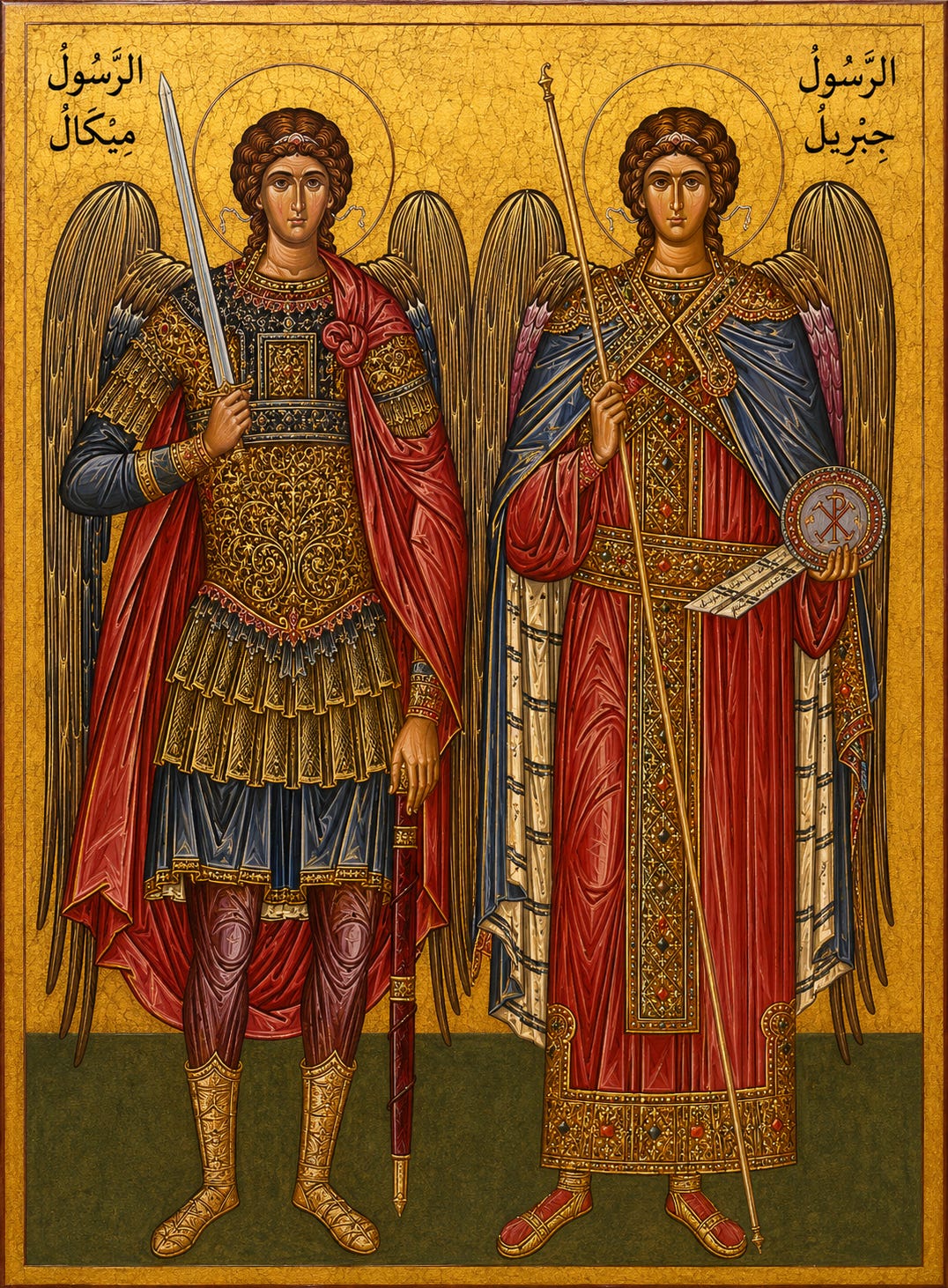
The Name That Weighs
Consonants bear the enduring lexical measure of Semitic words; vowels and patterns breathe that measure into reality, where it confronts the hearer with judgment.
Μιχαήλ (michael) / מִיכָאֵל (mikaʾel) / مِيكَال (mīkāl)
The angel whose name asks whether any power within the whole can be compared to the God who governs the whole
The Question in the Name
The name Michael is not a statement but a question, and Scripture would have it heard as one. In the Hebrew Bible the name stands as mikaʾel (מִיכָאֵל), and the conventional parsing breaks it into three pieces: mi (מִי), who; ke (כְּ), like or as; ʾel (אֵל), God. The surface function is who is like God. It is not a request for information. It is a challenge, and the answer is already folded into the asking: no one.
Greek does not translate the name; it preserves it. Written michael (Μιχαήλ), the chi carries the Hebrew kaf across into Greek, an aspirated k in the older pronunciation that later hardened toward the familiar ch. The sound keeps the Hebrew question intact even as the word becomes a proper name. Mi-cha-el, who-like-God.
The Qurʾan names Michael once, and in a shorter angelic form, Mīkāl (مِيكَال), set beside Gabriel, Jibrīl wa-Mīkāl (جِبْرِيلَ وَمِيكَالَ)—Qurʾan, Sūrat al-Baqara سورة البقرة “The Cow” 2:98. The Qurʾanic Mīkāl is shorter than the later expanded Arabic Mīkāʾīl (مِيكَائِيل), and the brevity matters, because it keeps the consonantal profile close to m-k-l, without foregrounding the longer form.
The Grammar of the Whole
Hebrew kol (כֹּל) and Arabic kull (كُلّ) are direct Semitic cognates, each functioning as all, every, the whole. They matter here because the middle of the name, the k-l that sits inside mikaʾel and Mīkāl alike, resonates with the same consonantal field. The point is not that Michael functions as whole, which it does not; the name parses as who is like God. It is that Scripture’s own grammar lets the question in the name be heard against its own steady refrain, that the whole belongs to God.
The Breath in the Pattern
A Semitic name is less a word than a measure waiting to be filled, a wazn (وَزْن), the template the Arabic grammarians weigh, what the Hebrew weighs as the mišqal (מִשְׁקָל). The bare skeleton is consonantal, here the m-k-l the name shares with kol and kull, the seen frame of all and whole, and the consonants alone do not yet speak; they wait upon the measure. What fills the measure is breath, the vowels, and the vowels are carried into writing by the weak letters, the matres lectionis of the Hebrew grammarians and the ḥurūf al-ʿilla (حُرُوف الْعِلَّة) of the Arabic, the letters ʾalif, wāw, and yāʾ. The two names weigh differently. The Latin of the medieval Hebraists, mothers of reading, sets the letters in service of the reader’s eye, but the Hebrew it renders, ʾimmot haqqeriʾah (אִמּוֹת הַקְּרִיאָה), turns on ק-ר-א (qof-reš-ʾalef), to call, to cry aloud, the same function as ق-ر-أ (qāf-rāʾ-hamza) that names the qurʾān itself, the recitation; the mothers are mothers of calling, not of silent reading. And the Arabic name never looked at the reader at all: ḥurūf al-ʿilla, the letters of weakness, says what the letters are, weak, mutable, liable to fall, weighed by the grammar and found wanting. These three are the breath-letters, consonants that double as vowel and prolongation, the unseen made audible. They are precisely the mechanism by which God fills the measure to produce the name.
In mikaʾel (מִיכָאֵל) the filling is the work of two of them. The yod is the vowel-letter of the interrogative mi (מִי), who, marking its long i and carrying no separate weight of its own; and the ʾalef, the first of the letters, the letter that opens the divine name itself, carries the a and seals the name in ʾel, God. The consonants set the skeleton; the breath-letters breathe the question into it and close it upon God. The Arabic keeps the same economy, for Mīkāl (مِيكَال) is the yāʾ of the long ī and the ʾalif of the long ā, the same two breath-letters holding the same pattern open. And when the Qurʾan first speaks the name it speaks it on a breath, wa-Mīkāl (وَمِيكَال), the wāw of joining set at its head (Sūrat al-Baqara 2:98).
And the interrogative does more than vocalize; it redirects. Mi, who, is the personal interrogative, not mah (מָה), what, so the name turns away from the whole, kol, which is a what, a thing to be owned, and asks after a person instead. Yet it names no person. It holds the subject open, an empty slot that the predicate ke-ʾel, like God, will let no creature and no totality fill, and so it drains every candidate out of itself until God alone answers. The one who heard the question is left standing not as its subject but as its respondent, no longer the thing compared but the one now to be weighed.
That the breath-letters are doing the work shows in how the name will not sit still. Across the recitations it is Mīkāl, then Mīkāʾīl, and more, the weak letters appearing and receding while the consonantal skeleton holds, the visible sign that the name is filled by breath rather than fixed in stone. God fills the pattern. The seen consonants are m-k-l, the frame of the whole; the unseen breath that makes them a name, and a question, is the ʾalif, the wāw, and the yāʾ.
The Whole as Gift
Genesis begins not with prohibition but with the whole given away. The first command concerning the human and the trees opens with mikkol (מִכֹּל), from every: from every tree of the garden you shall surely eat, mikkol ʿeṣ haggan ʾakol toʾkel (מִכֹּל עֵץ־הַגָּן אָכֹל תֹּאכֵל, Genesis 2:16). The whole garden is handed over as provision before a single boundary is named. The biblical grammar begins with the whole as gift.
The serpent attacks exactly there. Did God really say you shall not eat from every tree, he asks, taking the language of mikkol, every, all, and bending it toward suspicion (Genesis 3:1). The gift, from every tree you may eat, becomes in the serpent’s mouth a withholding, has God kept every tree from you. The turning away from God’s instruction begins when the human loses the grammar of gift and hears the whole as deprivation. This is already the false answer to the question in Michael’s name, for only God can give, govern, measure, and limit the whole, and the creature who grasps at the whole has answered who is like God with himself.
So Eden ends with the whole guarded. God sets the cherubim, hakkerubim (הַכְּרֻבִים), and the flame of the turning sword, lahaṭ haḥereb hammithaffeket (לַהַט הַחֶרֶב הַמִּתְהַפֶּכֶת), to guard the way to the tree of life, derek ʿeṣ haḥayyim (דֶּרֶךְ עֵץ הַחַיִּים) (Genesis 3:24). The issue is not merely a tree but the way to life itself. The whole is no longer open to grasping hands, and access to life is guarded because life belongs to God.
The Prince Who Is Not the Whole
When Michael himself appears, he appears as a prince, not as the whole. In Daniel he is named three times, and each naming holds him in his place. He is mikaʾel ʾaḥad hassarim hariʾšonim (מִיכָאֵל אַחַד הַשָּׂרִים הָרִאשֹׁנִים), Michael, one of the chief princes (Daniel 10:13); mikaʾel sarkem (מִיכָאֵל שַׂרְכֶם), Michael, your prince (Daniel 10:21); mikaʾel hassar haggadol (מִיכָאֵל הַשַּׂר הַגָּדוֹל), Michael, the great prince (Daniel 12:1). He is great, but he is not God. He is one of the princes, with an assigned office, standing for a people, contending without grasping. He is derivative of his King, his authority lent and never seized.
So his name becomes his own warning. Who is like God—not Michael, not the prince of Persia, not the prince of Greece, not any angelic ruler. His greatness does not compete with God’s uniqueness; his very name forbids the comparison. He is a heavenly power whose name says, do not mistake any heavenly power for God. The angel who fights for the people is himself marked by the question, and the answer stays the same: no one.
The Turning of the Letters
The Arabic grammarians give a name to what happens when a root is turned upon itself, qalb al-ḥurūf (قَلْب الْحُرُوف), the inversion of the letters, in the books of ṣarf, al-qalb al-makānī (الْقَلْب الْمَكَانِي), the positional turn; and the doctrine beneath it is Ibn Jinnī’s al-ishtiqāq al-akbar (الِاشْتِقَاق الْأَكْبَر), the greater derivation, the claim that a set of consonants reordered opens onto a neighboring field of sense, the very principle by which al-Khalīl ordered the first lexicon of the language through the permutations of each skeleton, Ezekiel’s bones. Turn the m-k-l of the name and it falls into m-l-k, the root of king. Hebrew hears it in melek (מֶלֶךְ) and malkut (מַלְכוּת), king and kingdom; Arabic hears it in malik (مَلِك) and mulk (مُلْك), king and dominion. And the same Arabic root gives malak (مَلَك), angel, so that the angel is named, by the turn of his letters, in the very consonants of the kingship he does not hold. Michael is malak, not malik. He carries the letters of the king and is not the king.
The Hebrew sharpens it with a single letter. Its word for the angel is malʾak (מַלְאָךְ), messenger, the one sent, the consonants of melek parted by an ʾalef, the same breath-letter that filled the name. By that one letter the messenger is divided from the king: melek is the one who sends, malʾak the one sent. Michael is the messenger of the King. He bears the King’s word, not the King’s throne, and the word he is sent to carry is a question, who is like God.
For there is only one king, and this is the burden of the whole book of Daniel. The kingdom is not Nebuchadnezzar’s, driven out until he knows that the Most High is ruler over the realm of mankind; it is not Belshazzar’s, whose kingdom was numbered and brought to an end; it is not the prince’s. His kingdom is an everlasting kingdom, malkuteh malkut ʿalam (מַלְכוּתֵהּ מַלְכוּת עָלַם), and his dominion endures from generation to generation (Daniel 4:3). The Qurʾan says it in the turned root itself, blessed is he in whose hand is the dominion, bi-yadihi l-mulk (بِيَدِهِ الْمُلْكُ)—Qurʾan, Sūrat al-Mulk سورة الملك “The Dominion” 67:1. The prince holds an office; the mulk is God’s. Michael guards a people and contends for a kingdom, and stands beneath the one King whose name his own inverts but cannot claim.
The Witness of Enoch
The Book of Enoch, heard whole in Geʿez, tells the same story in its text and, more quietly, in its roots. Through its chapters Michael intercedes before God (1 Enoch 9), binds the Watchers at command (1 Enoch 10), instructs Enoch in the hidden things, and guards the great oath by which creation holds its order (1 Enoch 69), yet never on his own warrant; he is commissioned, he reports, he stands before the throne of the Lord of Spirits. His authority is delegated and never his own. The text alone would confirm the name. But the language confirms it in the letters.
For Geʿez is itself a Semitic tongue, as Blaise Webster notes in his foreword to Seen and Unseen, the earliest attested of the Ethiopic branch and a keeper of the old pharyngeals, the ʿayin and the ḥet; its roots are not strangers to the Hebrew and the Arabic but kin. The whole is there in the tongue of Enoch, for Geʿez kʷell (ኵል) is the cognate of kol and kull, all and every and the whole, and it belongs where it always belonged. Michael is there as what his office makes him, a malʾak (መልአክ), a messenger, the one sent, from the same l-ʾ-k that gives the Geʿez verb laʾaka, to send. And the turn of the letters lands harder here than anywhere. In Hebrew m-k-l turned becomes melek, king; in Arabic malik and malak. But in Geʿez the crown was moved off that root, for nəgus (ንጉሥ) took the word for king, and m-l-k rose instead to name God: ʾAmlak (አምላክ), the ordinary Geʿez word for God, stands as a broken plural upon malik, king, and malakot (መለኮት) is Godhead itself. The turned letters of the whole do not stop at a king in Ethiopic. They spell the divine.
So the distance the name measures is written into two words that stand a single breath apart. The messenger is malʾak; the one he serves is ʾAmlak. Angel and God are one send-root and one ʾalef between them, m-l-ʾ-k against m-l-k, and Michael stands forever on the near side of that letter. He is malʾak, never ʾAmlak. The language that alone preserves his book answers his name within its own roots: the whole is kʷell and the crown is ʾAmlak, and both are God’s. The greatest of the messengers guards the order he did not lay and carries the word he did not speak, and his name, turned upon itself in the tongue of Enoch, spells the very God to whom none is like.
The Counterfeit ʾAmlak
Set ʾAmlak beside another word and the ʿayin does its work. The Arabic grammarians name the turn al-ibdāl (الْإِبْدَال), the substitution by which one letter stands in for another, and they know the ʾalif and the ʿayn as an interchange pair, throat-letters both, ḥurūf al-ḥalq (حُرُوف الْحَلْق), so near in the mouth that a whole dialect sounds the one for the other, the ʿanʿana (الْعَنْعَنَة) that says ʿan for ʾan. Two such substitutions stand between the divine name and its shadow, and each is an ibdāl pair: the ʾalif turns to its throat-neighbor the ʿayn, and the kaf turns to its back-neighbor the qof. So ʾAmlak becomes ʿAmaleq (עֲמָלֵק) in the Hebrew and ʿAmāliq (عَمَالِيق) in the Arabic, and the Arabic hides a gift in the turn, for ʿimlāq (عِمْلَاق) is the giant, the colossus swollen past his measure. The core that survives both turns is m-l, the letters of the crown and the whole. ʿAmaleq is the shadow cast by the divine name, the counterfeit ʾAmlak, God defaced in the throat and swollen to the stature of a giant.
And the Arabic lexical tradition remembers this on its own. In the ḥadith of Khabbāb preserved under the root ع-م-ل-ق (ʿayn-mīm-lām-qāf) in the Majmaʿ Biḥār al-Anwār of Muḥammad al-Fattinī (Majmaʿ Biḥār al-Anwār fī Gharāʾib al-Tanzīl wa-Laṭāʾif al-Akhbār, ArabicLexicon, ed. Hawramani), a father finds his son sitting with a storyteller, a qāṣṣ, takes up a whip, and asks, a-mina l-ʿamāliqati ʾanta (أَمِنَ الْعَمَالِقَةِ أَنْتَ), are you one of the ʿAmāliqa? The lexicon lays out the field: the ʿAmāliqa are the jabābira, the giants of al-Shām, remnants of ʿĀd, and the singular is ʿimlīq or ʿamlāq, the counterfeit name itself; and the verb ʿamlaqa is to speak the far-fetched word, so that the storytellers are likened to them for the arrogance in some of them, and because they deceive the people by their speech, which the lexicographer judges the more likely account. The counterfeit, the tongue remembers, is swollen not only in stature but in speech. The serpent had already spoken this way about the whole, bending mikkol toward suspicion; the malʾak carries a word not his own, and the ʿimlāq speaks his own bigness.
Have you not considered how your Lord dealt with [عَاد (ʿĀd)]—[with] [إِرَمَ (Iram)]—who had lofty pillars, the likes of whom had never been created in the land?
—Qurʾan, Sūrat al-Fajr سورة الفجر “The Dawn” 89:6–8
Iram is dhāt al-ʿimād (ذَات الْعِمَاد), of the pillars, the stock remembered by what it raised, and the pillar will stand once more in the text, for when Saul spares the counterfeit he raises one of his own, a hand of stone at Carmel.
And the shape of the word confesses the counterfeit before any lexicon glosses it. The Semitic root measures three letters, and ع-م-ل-ق (ʿayn-mīm-lām-qāf) is a quadriliteral, a skeleton past its own measure, the frame of m-l-k grown a fourth limb. Then the singulars swell again, and they swell by the very letters of the name. Mīkāl is filled by two breath-letters, the yāʾ of the long ī and the ʾalif of the long ā, and the lexicon’s two singulars seize exactly these two: ʿimlīq drops in the yāʾ, and ʿamlāq drops in the ʾalif, the same dropped-in ʾalif by which al-ṣamad, the solid one, is mispronounced into al-ṣamād, the manufactured stopper, the man’s attempt to seal his own hollow and pass for the solid One, as I trace in A Cork for the Earthen Vessel. In the name of the messenger the breath-letters are God’s to fill; the counterfeit shadows the name letter for letter and fills the measure himself. The giant is not a larger man. He is a root inflated past the measure set for it, the letters of king-and-god stretched until they play the God they spell, the false attempt at appearing like God written into the morphology itself.
And the text says what the counterfeit grasped for. In the mašal of Balaam, ʿAmaleq is reʾšit goyim (רֵאשִׁית גּוֹיִם), the first of the nations, whose end is destruction (Numbers 24:20). To be first of the nations is to seize m-l-k, to be first of the whole, king and God at once, the same grasp Michael’s name forbids, now wearing a name of its own. This is what stood under the ḥerem (חֵרֶם), the ban of utter destruction laid on Amalek, and this is what Saul would not destroy. He spared Agag and the best of the flock, and at Carmel he set up for himself a monument, a yad (יָד), a hand of stone (1 Samuel 15:9, 15:12). He built a shrine to the very thing the ban had marked for the fire, a house for ʿAmaleq, king-and-god. The self that will not destroy the counterfeit ends by enshrining it, and Saul, who kept the pretension alive, is himself weighed and set aside.
So the war is joined at the point of the name. Michael, whose name asks who is like God and answers no one, is the undoing of ʿAmaleq; and when the Revelation shows the last of the counterfeits, the dragon, the serpent of old, the one called the devil and the adversary, saṭan (שָׂטָן), it is Michael who casts him down (Revelation 12:7–9). The Book of Enoch is the key to that victory, for there Michael already binds the grasping powers, the Watchers who left their station and the giants they fathered, and holds the oath that keeps the whole in order. The victory is shown before it is won. The name that empties every rival subject toward God is the name that throws down the one who reached for the ʿayn where the ʾalif belonged, and would be ʾAmlak himself.
The Watcher and the City
And Enoch’s book has a name for the powers Michael binds, and the name carries its own indictment. The name is Daniel’s Aramaic, though Daniel’s watcher story names no Michael and knows no fallen ones; there the office stands in good order: ʿir weqaddiš min-šemayyaʾ naḥit (עִיר וְקַדִּישׁ מִן־שְׁמַיָּא נָחִת), a watcher, a holy one, descended from heaven (Daniel 4:13), and the sentence upon the great tree goes out by the decree of the watchers, bigzerat ʿirin (בִּגְזֵרַת עִירִין), that the living may know that the Most High is ruler over the realm of mankind (Daniel 4:17). The watcher, ʿir (עִיר), is the wakeful one, from ע-ו-ר (ʿayin-waw-reš), to be awake, to keep vigil. And that is why the ʿir comes in a dream: the wakeful one descends upon a man asleep, beḥezwe reʾši ʿal-miškebi (בְּחֶזְוֵי רֵאשִׁי עַל־מִשְׁכְּבִי), in the visions of my head upon my bed (Daniel 4:13), the vigil meeting the king who has none, the knowledge handed to the builder while he lies unconscious, received and never seized, for the dream is the one place beyond man’s grasp. And the same seen letters spell the city, ʿir (עִיר), the ʿayin and the reš holding the frame with only a weak letter between them, the breath again, where the skeleton stays fixed. The watcher and the city stand on one consonantal field, and the grammar is the argument, not a symbol, not an allegory, not a resemblance of themes, for in these scrolls the seen letters do the deciding. And Daniel has already let them decide, for the decree the watchers carry falls on the king at the very moment of his boast, is this not Babylon the great, which I myself have built, di-ʾanah benaytah (דִּי־אֲנָה בֱנַיְתַהּ, Daniel 4:30); the watcher stands against the city before Enoch ever speaks.
And one psalm holds the whole field in two verses. Unless the Lord builds the house, its builders toil in vain, šawʾ ʿamelu bonaw (שָׁוְא עָמְלוּ בוֹנָיו); unless the Lord watches the city, ʿir, the watchman stays awake in vain, šawʾ šaqad šomer (שָׁוְא שָׁקַד שׁוֹמֵר); to his beloved he gives in sleep, lidido šenaʾ (לִידִידוֹ שֵׁנָא, Psalm 127:1–2). Building, the city, the watch, every undertaking of the wakeful hand is vain where God does not do it himself, and the gift comes down in sleep, where the builder’s hands are down. Even the toil is spelled against the builder, for ʿamelu runs on ע-מ-ל (ʿayin-mem-lamed), the toil that sits seen inside ʿAmaleq. And this is a second operation of the grammar, not the first heard twice: by al-ibdāl the word was the defaced ʾAmlak, the ʿayn an intruder in the throat; by al-ziyāda (الزِّيَادَة), the augmentation that stretches a bare root toward a heavier measure, al-ilḥāq (الْإِلْحَاق), the attachment the grammarians name when a triliteral takes an added letter to stand in the four-letter class, and by Ibn Fāris’s al-naḥt (النَّحْت), the carving that hears the quadriliterals as compounded of triliteral cores, each keeping its function inside the bigger word, the word is ʿamal, toil, with the qāf dropped in, toil attached to a measure above its station. Two operations, one verdict: the grasper is condemned from either end of the word. The psalm is the warrant for the dream: what the watcher brought Nebuchadnezzar on his bed, the psalm had already sung over every city.
And the text has already said what the city is. The first city rises under a judgment, for Cain’s sentence had already emptied his toil: when you work the ground, ki taʿabod ʾet-haʾadamah (כִּי תַעֲבֹד אֶת־הָאֲדָמָה), it will no longer yield its strength to you; you will be a vagrant and a wanderer on the earth, naʿ wanad (נָע וָנָד) (Genesis 4:12). The psalm’s verdict was Cain’s sentence first, toil that yields nothing and no house to keep. And the city is his answer to the sentence: Cain built a city, wayehi boneh ʿir (וַיְהִי בֹּנֶה עִיר), the banah (בָּנָה) of deliberate manufacture, the same verb Nebuchadnezzar will raise in his boast and the watchers’ decree will fell, a settlement raised against the decree of wandering, and he named it for his son Enoch, ḥanok (חֲנוֹךְ) (Genesis 4:17). But there is a second Enoch, and he does not build; he walks: wayyithallek ḥanok ʾet-haʾelohim (וַיִּתְהַלֵּךְ חֲנוֹךְ אֶת־הָאֱלֹהִים), Enoch walked with God, and he was not, for God took him (Genesis 5:24). As Tarazi hears it in The Rise of Scripture, this Enoch recovers his true destiny: God intervenes to renew him, flesh made obedient to God’s will, and he stands as the prototype of Noah, of Abraham, of every slave after him who walks before God, the line not a bloodline but the scriptural path of obedience, the human as obedient shepherd rather than king, city-builder, or master of his own destiny. And the genealogy itself marks him, for the refrain of Genesis 5 is and he died, wayyamot (וַיָּמֹת), generation after generation, and at Enoch alone the refrain breaks: not and he died, but he was not, for God took him. There the book of Enoch finds its opening, for the taken one, not the dead one, is the one who walks on with God. One Enoch names a city; the other names a path.
So when the book that bears the second Enoch’s name calls the fallen powers Watchers, the grammar has already tried them. The wakeful ones descend, teach what was not given them to teach, the forbidden crafts and the hidden knowledge, take wives, and father the giants; the Greeks told the same story of Prometheus and called the theft a gift. Their knowledge is the knowledge that raises the polis (πόλις), and the book, heard whole, is a critique of Hellenism, of the civilization of the city, the polis of the Greeks standing where the city of the sons of Cain has always stood. Against them stand the messengers who keep their watch, Michael, Uriel, Gabriel, wakeful ones who remember that their wakefulness is an office and not a possession, derivatives of the King who posted them.
And Scripture never gives the human watchman the watcher’s root. The ʿir, the wakeful one, belongs to heaven; when God posts a man on the wall he posts a ṣofeh (צֹפֶה), from צ-פ-ה (ṣade-fe-he), to look out: son of man, I have appointed you a watchman for the house of Israel; whenever you hear a word from my mouth, warn them from me (Ezekiel 3:17; 33:7). And the commission empties the looking into hearing, for the ṣofeh keeps his post with his ears, and the word he relays is not his own. Wakefulness itself is kept for God, for the keeper of Israel, loʾ yanum weloʾ yišan šomer yisraʾel (לֹא יָנוּם וְלֹא יִישָׁן שׁוֹמֵר יִשְׂרָאֵל), he neither slumbers nor sleeps (Psalm 121:4), and the šomer is a third root again, lent to no man. The grammar’s refusal is the instruction: the vigil is not handed to men, only the word is. And the Watchers’ sin stands the sharper for it, heavenly ʿirin who taught on the vigil as if it were theirs, against a man given no vigil at all, warned and warning, knowledge governed by God against knowledge seized, the vigil turned into a city.
The Qurʾan says where all such knowledge sits, and it is the angels who say it: subḥānaka lā ʿilma lanā illā mā ʿallamtanā (سُبْحَانَكَ لَا عِلْمَ لَنَا إِلَّا مَا عَلَّمْتَنَا), glory to you, we have no knowledge except what you have taught us (Sūrat al-Baqara 2:32). That is the confession of the watch kept. The Watchers of Enoch are the watch abandoned, powers who forgot their place, assumed godhood, and answered the question in Michael’s name with themselves. The field of the seen letters holds in Daniel and in Enoch, deciding between the watcher and the city; and the ṣofeh stands deliberately outside it, the man kept off the watcher’s root altogether, so that the two Enochs remain the only choice the grammar leaves, the walker and the city.
The Measure of the Hearer
But a measure measures. The wazn that shapes the name is also the scale on which its hearer is weighed, for to hear mikaʾel, who is like God, is to be set on a balance and asked for an answer. The same Daniel who names Michael knows the verdict the scale can return, teqiltah bemoʾzanyaʾ wehištekaḥt ḥassir (תְּקִילְתָּה בְמֹאזַנְיָא וְהִשְׁתְּכַחַתְּ חַסִּיר), you have been weighed in the balances and found wanting (Daniel 5:27). The root that weighs there is the root of the mišqal and the wazn, and the measure of the name becomes the measure of the man.
So the messenger’s name is a test. A messenger’s name is never neutral; it is put to the hearer as a trial, and the angels say as much, for at Babylon the two who taught what they taught warn innamā naḥnu fitna (إِنَّمَا نَحْنُ فِتْنَةٌ), we are only a trial, so do not disbelieve (Sūrat al-Baqara 2:102). The named heavenly power is a fitna (فِتْنَة), a test set before the one who meets it, and Michael’s name is that test stated as a question. Answer it with any power, any prince, any kingdom, any self, and the balance finds you wanting; answer it with no one, and you are weighed true, for you have handed the whole back to its owner. The messenger does not administer the test from outside. He carries it in his name.
Among the Slaves
The Qurʾan sharpens this by placing Michael among the slaves of God. In the same verse he is named beside Gabriel, Jibrīl wa-Mīkāl, yet both are set beneath God: whoever is an enemy to God, his angels, his messengers, Gabriel, and Michael, God is an enemy to the unbelievers (Sūrat al-Baqara 2:98). The order is plain, God above his angels, his messengers, Gabriel, Michael. Michael is honored, but he is not independent; he belongs to the order of God’s slaves. The Qurʾan refuses any elevation of Michael beyond that rank.
And in the same world, the Qurʾan gives the whole, kull, to God again and again. Every thing, kullu shayʾ; knowing of every thing, bi-kulli shayʾin ʿalīm; powerful over every thing, ʿalā kulli shayʾin qadīr; to him the whole matter returns, ilayhi yurjaʿu l-amru kulluhu. The Qurʾanic world is saturated with the grammar of kull, and the whole is God’s domain. Within that same world Mīkāl is named only as an angel. The question implied by the Hebrew name is answered Qurʾanically by the steady grammar of kull: the whole belongs to God alone.
The Heir of the Whole
And here the Pauline grammar meets the Hebrew name. To answer who is like God with oneself is precisely what Paul names harpagmos (ἁρπαγμός), a thing to be grasped, the equality with God that the one in the form of God refused to seize (Philippians 2:6). Michael’s name forbids the grasp before it is made. Yet the same Scripture that shuts the whole against grasping hands gives it away whole to those who will not grasp: the inheritance, kleronomia (κληρονομία), comes through a single heir, kleronomos (κληρονομός), heir and not heirs, and not by the allotment of Law but by trust (Romans 4:13–14). There are no portions to divide. The whole is open to all because it is taken by none; each receives it entire by submitting to the one who owns it, or receives nothing at all. To grasp at the whole is to lose it; to let it remain God’s is to be given all of it.
The Answer
The traditional parsing, who is like God, does not need to be overthrown. It needs only to be heard in full. Because Scripture everywhere shows God as the one who owns, gives, governs, measures, and gathers the whole, kol and kull, Michael’s name can be heard as the angelic question set before every creaturely power: who is like God, the Lord of the whole. Daniel answers, not the princes, not the kingdoms, not Michael himself. Genesis answers, not the human who grasps at the tree. The Qurʾan answers, not Gabriel, not Michael, not any angel or messenger.
Michael is not the one from the whole. He is the angel whose name asks whether any power within the whole can be compared to the God who governs the whole. And the answer, across the Bible and the Qurʾan, is the same. No. God alone is the Lord of all.
And the question, heard to its end, hands over a gift. The system by which this essay spells its hearing is named Andalus, as introduced in Rise, Andalus, and not because the Umayyad house was a utopia; the dynasty was itself a building, weighed like every building. What the name remembers is the koinonia (κοινωνία) of Jew, Greek, and Muslim, the scrolls heard together in three tongues, placed in the empty hand and owned by no one, and rejected in the end by the tower builders, whose fathers had already spoken the whole program at Babel: come, let us build for ourselves a city and a tower, nibneh-lanu ʿir umigdal (נִבְנֶה־לָּנוּ עִיר וּמִגְדָּל), and let us make for ourselves a name, wenaʿaseh-lanu šem (וְנַעֲשֶׂה־לָּנוּ שֵׁם) (Genesis 11:4), the manufactured name against the name that asks. That koinonia is the gift carried in the answer to Michael’s question. The question levels everyone it weighs, Jew, Greek, and Muslim alike, and the leveling is the fellowship, for the whole is open to all only where it is owned by none. All of us are nothing, as Paul says: whoever thinks he is something when he is nothing, meden on (μηδὲν ὤν), deceives himself (Galatians 6:3). No one is like God. That is the answer, and in the empty hand it is the gift.