
The Outer Face, ص
The decisive question is not whether peace is found, but how the heart is turned when it faces the partition God has raised.
Two Trodden Ways
צ-ר-ב (ṣade-reš-bet) / ض-ر-ب (ḍād-rāʾ-bāʾ)
A wall struck between two peoples, and the side that faces you
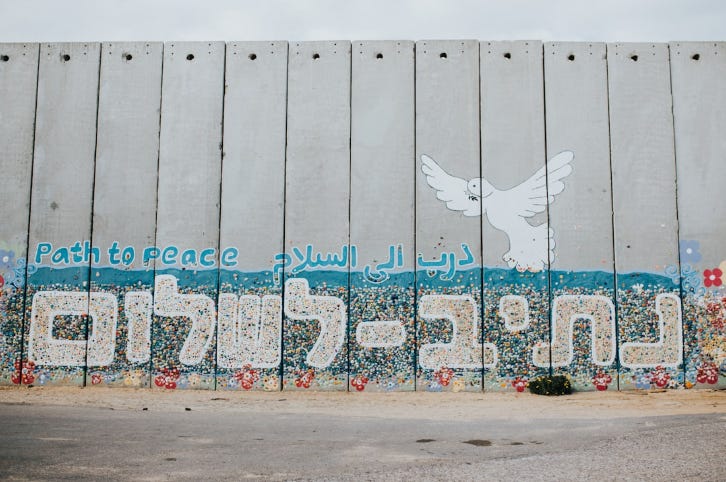
I chose Cole Keister’s photograph for The Measure of the Heart, the essay in which I followed tawakkul (تَوَكُّل), the Arabic surrender, back to the meeting of two Hebrew functions: the trust that lays itself down, and the ability that learns it cannot. The picture found its place. A white dove crosses a field of painted flowers, an olive branch in its beak, and across the grey concrete three tongues say one thing—Path to Peace, darb ilā al-salām, netib le-šalom. To the eye it is hope. I let it stand for hope.
But the words would not fade from my ears. A sign is never only what it says; it is also where it is written, and these words are written on a wall.
Set the Semitic lines side by side. The Arabic darb (دَرْب) and the Hebrew netib (נְתִיב) are not cognate—darb turns on a beaten pass cut through hard country, netib, on נ-ת-ב (nun-taw-bet), the line worn across open ground where feet have repeatedly crossed. Yet both inscriptions reach past the ordinary road. The Arabic does not say ṣirāṭ (صِرَاط), the straight path the Fātiḥa prays each day, nor sabīl, nor ṭarīq, the common words for a way; the Hebrew does not say derek. Each chooses instead the marked word for a track made only by walking, a way that exists because it has been gone. And both terminate in the same function, salām (سَلَام) and šalom (שָׁלוֹם), the s-l-m of wholeness that the two languages shared before any brush touched the wall. In the Arabic the word even carries the article, al-Salām, the Name itself: a road that ends not at a condition but at God, who is Peace. So far, hope. This is the face the sign turns to the eye.
The Shadow in the Strike
Now hear what the painter did not write. Darb is correct Arabic, but it is not the Qurʾan’s word; the function never enters the text. What does enter the text, everywhere, is its near-neighbor, one articulation away—ض-ر-ب (ḍād-rāʾ-bāʾ), ḍaraba (ضَرَبَ), to strike. The lexica keep the two apart, and they are apart: darb is dāl, the strike is ḍād, and no honest eye collapses them. The resonance is the ear’s, not the dictionary’s. But a painted word rides a surface, and this surface is not paper. It is a wall—and the Qurʾan has a verse for a wall that is struck.
It comes on the Day the hypocrites call across the dark to those who carry light, begging to borrow a little of it, and are sent back empty to look for their own:
So a wall [سُور (sūr)] is struck up [ضُرِبَ (ḍuriba)] between them, having a gate; its inner side holds the mercy, and its outer side, facing them, the torment.
—Qurʾan, Sūrat al-Ḥadīd سورة الحديد “Iron” 57:13
The verb is ḍuriba, the passive of the strike. What it strikes up is sūr, a wall, baynahum (بَيْنَهُم), between them, between the faithful and the false on the last day. The whole scene is already the line my framing reached for: light on one side, the search for light failing on the other, and between them a partition struck. The Gospel tells it too, lamp in hand: five foolish parthenoi (παρθένοι) whose lampades (λαμπάδες) are failing beg oil of the wise, are sent to buy their own, and return to a thura (θύρα), a door, shut against them (Matthew 25:1–13). It is the hypocrites’ plea word for word—wait for us, that we may take of your light—and the same refusal, the same turning back to a light no one can lend. The painter’s wall, heard through its own root, is that wall. Darb summons ḍarb; ḍarb summons the verse; and the verse is judgment.
The Hebrew scroll does not leave the strike uncommented. Its formal cognate, צ-ר-ב, did not become a blow but a burning—ṣarebet (צָרֶבֶת), the scar a fire leaves, the faces scorched from south to north in Ezekiel. Strike and scorch are one violence sorted by a single letter, the mark that does not wash off. In my essay ʾAlif, Lām, Mīm, Ṣād — ʾAlif, Lām, Mīm, Rāʾ I heard the cut letter ṣād (ص) of the Qurʾan in צ-ב-ר (ṣade-bet-reš), the root of the thing heaped up; but note the turning of the letters—what the grammarians call qalb al-ḥurūf (قلب الحروف), the inversion that transposes a root’s radicals—for the root that names the heap, so turned, names the thing burned in, the scar that is left by sin.
The Side That Faces You
The verse divides the wall into two faces. Its bāṭin (بَاطِن), the inner and hidden side, holds raḥma (رَحْمَة), mercy; its ẓāhir (ظَاهِر), the outer and apparent side, holds ʿadhāb (عَذَاب), the torment. And the torment is placed with precision—min qibalihi (مِن قِبَلِهِ), from the side that faces, ق-ب-ل (qāf-bāʾ-lām), the facing-function, the root of the qibla and of every direction a heart is turned. The wall does not sort by any merit announced; it sorts by orientation, by which way you stand when it goes up.
Here is the warning the sovereign nafs (نَفْس) cannot hear. The self that takes itself for its own sovereign hears only the ẓāhir of the sign, its apparent face, and the apparent face is hope: a path, a dove, peace in three tongues. But the Spirit, the rūḥ (رُوح), hears the inner thing, and what it hears on this wall is a line already drawn between the light and the dark—not a promise that the wall will fall, but a question about which side of it you are facing.
And here the sword of the Spirit becomes functional. The same strike that raises the partition is the blade Paul names—ten machairan tou pneumatos (τὴν μάχαιραν τοῦ πνεύματος), the sword of the Spirit, which is the word of God (Ephesians 6:17). And that word, as Hebrews hears it, is living and active, sharper than any two-edged sword, diiknoumenos (διικνούμενος), piercing as far as the merismos (μερισμός), the division of soul and spirit (Hebrews 4:12). The Greek cuts the very line the Arabic strikes: psuche (ψυχή) is the nafs, pneuma (πνεῦμα) is the rūḥ, and the word falls between them as the wall falls between the faithful and the false. One cut divides the two hearings. The self hears only the ẓāhir because the blade has not yet reached it; the Spirit hears the bāṭin because the sword has already passed through. The hope is true. It is simply on the far side of a partition that has been struck, and the side that faces you is decided by the way you have turned.
And yet the struck wall keeps a bāb (بَاب), a gate. Its hidden face is mercy. This is the same architecture as Babel, where the scattering that looked like wrath was the form mercy took. The judgment does not abolish the mercy; it hides it on the inner side and leaves a door. So the sign on the wall does not lie. It is a path to Peace, to the Name. It only declines to tell the nafs what the rūḥ already knows: that the way to The Peace runs through a wall that is struck, that the gate is narrow, and that everything turns on the direction you are facing when you reach it. The measure of the heart, in the end, is a measure of its facing.
And the gate is not the Qurʾan’s alone, nor the wall. Both stand proclaimed aloud in the second scroll. There Paul tells the two peoples the partition holds apart—the near and the far—that the one who is himself their peace, autos…he eirene hemon (αὐτὸς…ἡ εἰρήνη ἡμῶν), has broken down the mesotoichon tou phragmou (μεσότοιχον τοῦ φραγμοῦ), the dividing wall, ten echthran (τὴν ἔχθραν), the enmity, in his flesh (Ephesians 2:14–16). The wall that ḍuriba raised between them, Christ lusas (λύσας) loosed; and what he loosed was not the slab but the enmity that is the wall’s true substance. The wazn (وَزْن) crystallizes the function a root was already carrying and hands it over as a dabar (דָּבָר), a reality; so the sign’s last word, Peace, proves to be not a place the road reaches but that dabar standing in the gap—al-Salām in the flesh, a Tree planted before there was a seed, the breach where the wall stood. And he stands there carrying both turnings of the cut letter: yiṣbor (יִצְבֹּר), the heap a man piles against the years of hunger, and the ṣarebet, the scar the fire burns in—the Suffering Slave of Isaiah, the mešullam (מְשֻׁלָּם, Isaiah 42:19), on whom fell the chastening for our well-being, šelomenu (שְׁלוֹמֵנוּ), our šalom (Isaiah 53:5). The ṣād (ص) cut closes in his body: ṣ-b-r shouldered, ṣ-r-b borne, š-l-m made whole. And the same Jesus names the gate the painter’s wall conceals and Sūrat al-Ḥadīd 57:13 leaves open—pule (πύλη):
Enter through the narrow gate [πύλης (pules)]; for the gate [πύλη (pule)] is wide and the way is broad that leads to destruction, and there are many who enter through it. For the gate [πύλη (pule)] is narrow and the way is constricted that leads to life, and there are few who find it.
—Matthew 7:13–14
